Wednesday, 17 October 2012

Great Film Moments #2: The finale of The Way of the Gun (2000)


Christopher McQuarrie's follow up to the legendary The Usual Suspects is a criminally unseen and highly entertaining genre pic, The Way of the Gun. While at the time hyped up to Tarantino levels of possible awesomeness, it never really delivered on that level. Owing more to Peckinpah than Tarantino, in retrospect you can see why the film failed to receive the acclaim and box office receipts of Tarantino's best efforts. This is a crime film with a bunch of arsehole lead characters trying to screw each other over from the very start. These people are all bad and McQuarrie makes no attempt to hide it. It's a very uneven film, that is sure, it can be very funny, quick witted and clever in parts, but there are moments that overrun and slow the film down to a crawl. That being said, the film has several stand out moments and will be what it's remembered for. The opening scene is a classic comic scene that doesn't suit the tone of the rest of the film, but is mightily funny and uses some colourful language. The kidnapping scene is as tense as they come, and uniquely plays with genre conventions. The motel shootout/sniper scene is a glorious scene that tests 5.1 Dolby Surround Sound to the limit. These scenes are up there with the most enjoyable in crime cinema, but it's the final bloody set-piece that steals the show.


"There's always free cheese in a mouse trap" - Longbaugh

As Parker (Ryan Phillippe) and Longbaugh (Benicio del Toro) make one last go for their fortune, they come across a legion of goons and Joe Sarno (the great James Caan). What follows is one of the finest choreographed action scenes in film history. As far as film goes, it is also up there with one of the most realistic takes on a gun battle, the action is all around, a fully realised battleground with danger incoming from 360 degrees. Which is refreshing. And most importantly, it's thrilling, tense and packs a mighty wallop. It's one of the loudest and most frantic set-pieces ever filmed (perhaps only beaten by Michael Mann's Heat) and for the first time in the film, you also want Parker and Longbaugh to succeed and get away. Bar one dreadful bit (the shotgun to the nuts, which looks bad and dated) and a scene where the realism slips for one endlessly deafening barrage of bullets to draw one helpless goon out, bullets fly, Parker and Longbaugh battle on furiously, but taking heavy damage. A genuinely squirm inducing scene involving the fountain and Parker ups the gore ante and sets up the finale, ominous reel. Despite that one scene, the set-piece doesn't rely on gore and bloodletting, rather the sound is amped up and it works wonders in giving the scene an epic sound (5.1 has never sounded better). It is action cinema at its very best. 


Saturday, 6 October 2012

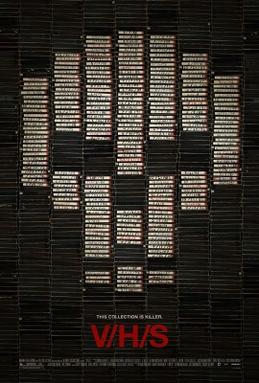
FILM REVIEW: V/H/S (2012)


Directors: Adam Winguard, David Bruckner, Ti West, Glenn McQuaid, Joe Swanberg, Radio Silence
Starring: Calvin Reeder, Lane Hughes, Adam Winguard, Hannah Fierman,  Mike Donlan
Running Time: 115 minutes
Genre: Horror anthology

The found footage gimmick is becoming stale. It's resurgence in recent years due to the success of the Paranormal Activity has brought up a host of cheap and tacky imitations trying the same trick over and over. V/H/S is a breath of fresh air in that regard. Unlike the majority of these films threats of near-misses for 90 minutes and then one big reveal at the finish, V/H/S goes straight for the jugular. It's gruesome, nasty, vile, ultra-violent and disturbing in parts, but one thing you can't deny is that it is an effective horror film that sticks a middle finger to the safe horror that is constantly being thrown into cinemas.

Rather than being one long haul, V/H/S is an anthology film, broken into six short segments (five of which are seen in one main arc called 'Tape 56'). This allows for greater variety in tone and style, which is often a hindrance on such films, where the found footage gimmick can wear thin pretty quick. Tape 56 suffers the most from being broken up in bit segments while the other shorts play and is the most confusing, but there are a few chills to be found, despite the group being a bunch of douchebags. The opening short, Amateur Night (directed by David Bruckner) is the best of the bunch. Following three guys on a night out, their drunken antics (except the quiet and nice guy of the group cameraman) and their inability to see that everything isn't okay with one of the chicks they pick up from a bar. Cue madness. This segment is bat-shit bonkers. The warning signs are evident for the boys early on and it's horror movie school 101 stuff, but is executed with such thrilling style and makes exceptional use of the found footage format. Visceral and pretty much every young man's nightmare, it's a fantastic opening segment. The second segment, Second Honeymoon (directed by Ti West) is a more subdued affair. Anyone who knows West's output will instantly know his involvement here. Slow building and full of quiet menace, a couple on their second honeymoon become victim of a deranged stalker. Here, the use of the found footage is haunting and eerily creepy. West's horror instincts (as seen in the great The House of the Devil and The Innkeepers and probably the main reason I wanted to see this film) are old school, the slow build, the ominous signs and the night scenes. They are beyond scary. The stalker using the couples camera is a master stroke. The menace and threat of the stalker in those scenes do more than the blood-letting that comes afterwards. The shockingly brutal climax will warrant a strong stomach and is about as explicitly violent a film can get without being censored. Be warned! 

The third segment, Tuesday the 17th (directed by Glenn McQuaid), plays with the slasher movie format and after the first two segments feels like a let down. It has its moments with some genuinely spooky flashes. One or two of the kills are rough and nasty, but the over-reliance on gore here (and some shoddy effects/fake looking props) hinder. It has its moments, but nowhere as effective as the previous two. The Sick Thing That Happened to Emily When She Was Young (directed by Joe Swanberg) is the weakest segment of the film. Relying on a Skype camera call scenario, a young woman who suspects there is a ghost in her apartment contacting her doctor boyfriend to keep a record of the events. There are scares to be had here, as the Paranormal Activity premise is turned on its head in pretty disgusting fashion. Two impromptu surgery scenes again keep the recurring theme of extreme gore at a high. This is perhaps the weakest segment of the film, but given the tricky and confining setting, it does well all things considered. The final segment is the most fun of the bunch, 10/31/98. Directed by Radio Silence, this segment has by far the most visual scares of the film, as a group of guys go to the wrong Halloween party and enter a real life house of horrors. The scares are not a gruesome as the previous segments and there is a lighter feel to this segment (for the opening exchanges anyway). The scares are great, giving more in jumps in 15 minutes that the combined Paranormal Activity franchise combined. 

V/H/S is a great horror film. Mean and nasty, but with enough clever touches to stop it from being exploitive, there are enough scares and blood here for hardcore horror fans. Definitely not for those with a weak stomach though. All involved have made an entertaining and genuinely unique take on a horror sub-genre that has relied on safe and basic scares. V/H/S rectifies this, with blood-soaked aplomb. Be warned, it is intensely violent and gruesome. One for Halloween then!

78


BOSS; the most underrated show on television


Starz is not a channel people would rank up there on the level of HBO and AMC for its programming output. Recently, with popular shows like Spartacus (haven't seen it, so I can't comment on the quality of the show) or the misfire that was Camelot; there have attempts at making grittier shows along with the likes Magic City and the upcoming Noir. But no have been successes on the level of the powerful brands of HBO and lately, AMC, whose shows Breaking Bad, The Walking Dead and Mad Men have seen the channel rise as a powerhouse of television. Boss was seen as being Starz answer to these shows and as a challenger. However, as seems common in the States, shows live and die based on viewing figures, with little regard for acclaim or critical praise. Even though Boss has made it to a second season, it's viewing figures have been abysmal and I'd be surprised if there'll be a third season. Which is a shame, because Boss is a pretty darn good show.

With this being billed as Kelsey Grammer's first serious lead-role away from his more comedic centred efforts for which he became famous for, it is a great and unsuspecting success. As Mayor Tom Kane, there is a new side to the man once fondly remembered as Frasier Crane. Tom Kane is a monster. A ruthless man with time against him. Diagnosed in the opening scene of the first episode as having Lewy bodies with dementia, we first see him at his strongest. This is the compelling point of this show. There will be no recovery for Kane. He is going downhill from the very first episode and unlike most shows when these problems tend to be resolved easily and thrown aside (something that always took away from Breaking Bad for me). Kane's battle to hide his illness from both his family and the public is a compelling look at a man losing control, who was perhaps not a likeable man before his diagnosis, but has become even more so as the series has progressed. Now I am not sure of the portrayal of Lewy bodies in the show, if it is a genuine portrayal of the illness or sensationalised for entertainment purposes. If it is a genuine portray; then it's a harrowing affliction as Kane (especially in the later episodes of season 1 and rises in season 2 and provides some of the seasons best scenes) loses his grip on reality, his hallucinations become more vivid and his mind veers away from stability. While not wanting to go into plot specifics and spoilers, Kane's conversations with right-hand man Ezra Stone (the terrific Martin Donovan) provide the series highlights. Stone's cool precision mixed with Kane's fury makes for thrilling television and even more so in the second series as the show evolves from political drama into a full blown psychological thriller. 

While not being the greatest show ever, it is great to see Grammer tackle more challenging projects. From start to finish of every episode, he is the focal point, confidently carrying each episode. It's Boss's greatest strength but also it's greatest weakness. This over-reliance on Grammer. While Donovan's Stone is the pick of the supporting characters, shows like the aforementioned Breaking Bad or classic shows of the highest calibre like The Sopranos and The Wire make use of a strong supporting ensemble, where often the supporting characters are the highlight; hello Mike Ehrmantraut and Christopher Moltisanti! Boss in this regard suffers. It is very much a one man show, for all the supporting characters plotting and scheming, they are not in the least memorable in the grand scale of modern television viewing. Which is a shame, because Grammer's Tom Kane is. Despite these flaws, the show is definitely worth having a look at, purely for Grammer's powerhouse performance. 


Friday, 21 September 2012

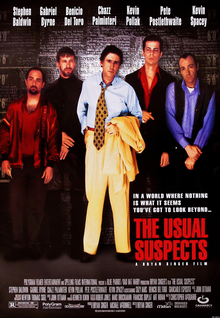
RETROSPECTIVE: The Usual Suspects (1995)

Director: Bryan Singer
Starring: Stephen Baldwin, Gabriel Byrne, Chazz Palminteri, Kevin Spacey, Kevin Pollak
Running Time: 106 minutes
Genre: Crime thriller

The Usual Suspects is my all time favourite film. Ever. It's one of the few films I've seen countless times and practically know every line off by heart. Everything about this film reeks of greatness. And it gets better with every viewing. That's saying something to the intricacy of the plot, the labyrinth plot and all round terrific performances on display. Director Bryan Singer and Christopher McQuarrie crafted a film so clever, so smart, that even on my gazillionth time re-watching it; I pick up on something new, a smile or a reference, something simple that wows me. It is a film so clever it makes you feel a bit silly at the end for getting duped. With the emergence of Tarantino as a premier film-maker in the earlier part of the 1990s, the crime genre became awash with cheap imitations and knock-offs of his work, the crime ensemble, the tough guys with sharp tongues, a taste for violence and visual flair filled with pop culture beats. Singer and McQuarrie wisely neglected to include the latter trait. There are no retro 70s classics, no talk about McDonalds and Burger King and so on. The film is very much a self-contained entity. And that's what makes it a masterpiece. Blissfully residing somewhere between the old fashioned crime caper and the aforementioned Tarantino stylism of the ninties, The Usual Suspects is too clever to resort to such things. Everything that happens is necessary in the overall context of the tale that is being told. And it's a mighty pay-off that lacks the bloated nature and unnecessarily over-long running time that often plagues films of this type. Everything about this film is perfection.

Kevin Spacey (as Verbal Kint) and Gabriel Byrne (as Dean Keaton)

The success of the film is in no small part to the magnificent cast. Gabriel Byrne gives a career best performance as Dean Keaton, a disgraced former cop who despite his best efforts to leave the crime world, is pulled down by vindictive former peers, including Agent Dave Kujan (Chazz Palminteri). Kujan meets with Verbal Kint, played by the wonderful Kevin Spacey, one of two who survived a brutal harbour shoot-out the night before. Kujan's mission is to find out if Keaton was one of the men that was killed. What follows is an intricate tale of five criminals as they become embroiled with a mysterious and myth like criminal named Keyser Soze. The crew, consisting of Keaton, Kint, McManus (Stephen Baldwin), Hockney (Kevin Pollak) and Fenster (Benicio del Toro). An early scene that cements their bond through being victimized as 'the usual suspects' for a police line-up sets the team up and they plan to get even on the corrupt police force. Keaton's reluctance puts Kint's role in the team at risk, but is persuaded by Kint after a heart-to-heart. Once the crew is assembled the action comes at a frantic pace. The robbery of a bunch of corrupt NYPD officers is a sharp and efficient set piece. It gives us an insight into both the solidarity of the team, but also that they are professionals. Again, if the five criminals were played by other actors they'd risk becoming generic cardboard canon fodder, but in Singer and McQuarrie's hands, each is uniquely likeable in their own way, even del Toro's Fenster who has far less screen time than the others, but still makes an impression ("Flip you, flip ya for real!") that you are rooting for the gang to succeed. 

One thing that is apparent from early on is that everything is not as it seems. Kujan, essentially represents us, the viewer and has enough intuition to know Kint is holding out. As Kujan finds out more (from other detectives interviewing a Hungarian survivor of the shooting) the plot thickens further. The introduction of Redfoot the Fence (Peter Greene) further adds to the mystery, with the crew now placed in danger and immediate threat. The scenes with Redfoot are some of the best in the film, and highlights the vulnerability of them under threat from the more powerful Redfoot and the introduction of Kobayashi (the late Pete Postlethwaite) into proceedings complicates matters further. Watching the group of macho males descend into paranoia and fear under threat from Soze is terrific in parts. Baldwin (in the performance of his career) as McManus and not like the man you'd probably know best recently as a member of Celebrity Big Brother is a revelation. In anybody else's film, Baldwin's McManus would be the lead, oozing charm, likeability and with machismo to spare. Similarly Pollak's Hockney is a secondary character, but is highly entertaining (thanks in part to Pollak's razor sharp delivery and wise-cracking sensibility) and you do nothing but root for him to succeed. While Kint's story too relegates himself to a secondary character, his petty criminal mixed in with career criminals make him a more relatable character and his wanting to get the job done without violence (well, unless it's necessary) make him the perfect narrator for the story. 

Stephen Baldwin (as McManus) and Kevin Pollak (as Todd Hockney)

But it is truly Byrne's Keaton that is the focal point of the film. Is Kint protecting him by making him out to be such a nice guy? All the questions that arise from Kint's story in contrast to Kujan's version of Keaton. It must be noted too that Palminteri excels as the determined cop who is essentially the straight man of the piece, he knows certain facts, but is drip fed information much like the audience and his piecing together of the facts is the same as the audiences. But back to Keaton, Kint's version of him is a highly complex character, a man whose life has seemingly been destroyed by his past, but does that even matter as do we ever know if he's telling the truth (well the finale clears this up, but we are left guessing practically until the final scene). And Kujan spiteful hatred of Keaton ("Dean Keaton was a piece of shit") further puts questions in Kint's representation of Keaton. With this in mind, it is still impossible not to root for the Keaton we experience. Initially a beaten figure, once he joins with the four he becomes the central figure of the operation with his insight into police procedures and gives the team enough information to do the job right. The mere mention of Soze to the four (excluding Kint, who hadn't heard of him) brings that forlorn and defeated look back and the sense of dread  that the films opening scene may actually be what happened and that Keaton didn't actually make it out of the harbour. 

Again, nothing is never as it seems and that's what makes this film such a job and complete mindfuck. The big harbour finale reeks of dread and something is really, really wrong here (along with all the brutal shootings of course). Certain films that tease this amount of complexity usually tend to fall off in the final act for a reveal so pointless and obvious that is ruins what came before it. The Usual Suspects does no such thing. The 'suspects' know they are in above their heads but resolve to do it anyway to get away from Soze's grasp. Whatever the outcome, they'll be free. Singer handles the action here with aplomb. The violence hits hard, but never feels unnecessary or becoming anything like gun porn. All the guns do is symbolize a threat that has been lingering for the 'suspects' for a long time, that Soze is close and the truth too (note in the scenes with Redfoot, his goons are heavily armed, but no action is taken, symbolizing the 'suspects' getting closer to Soze). Another part that drives the film is a fiendishly sinister score composed by John Ottman. From the opening theme right through, Ottman's score sets the mood. It is a strikingly gorgeous score that adds to an already strong central theme of mystery and intrigue for the film. 

Endlessly quotable, an iconic ensemble and perhaps the finest twist in modern film history, The Usual Suspects is not only the best film of the ninties, it is one of the all time greatest. A film that cleverly plays with genre expectations and turns them on their head, Singer and McQuarrie delivered the rarest of treats, a film as clever as it thinks it is, even on repeat viewings, the twists and turns hold up. The elaborate mixture of actuality and fiction mirror a truly wonderful piece of modern film-making. Add to the mix, an Oscar winning performance by Spacey (and screenwriting award for McQuarrie) and terrific all around performances beyond the usual filler typically associated with the genre and you have an all time classic. Just amazingly amazing.

95

The Suspects: Hockney, McManus, Fenster (Benicio del Toro), Keaton and Kint


TV REVIEW: The Shadow Line (2011)


Starring: Chiwetel Ejiofor, Christopher Eccleston, Stephen Rea, Rafe Spall, Antony Sehr
Genre: Drama

It is easy to forget that not too long ago British television was the pinnacle of programming. Long before the HBO's of this world came along, the BBC (and ITV too) were throwing out show after show of immense quality. The detective drama in particular being a staple of British television over the years and with The Shadow Line, the BBC have delivered a show that remains true to the age old BBC style, but adding modern threads of grit and themes utterly consistent with the finest shows from the States. The Shadow Line is not only the best British drama of recent years, it's one that down the line will be looked at in the same vein as Tinker, Sailor, Soldier, Spy as a classic of the conspiracy/noir genre, a complex and enthralling thriller that exceeds all expectations. 

From early on, creator, writer and producer Hugo Blick sets out to be different. The first scene in particular sets up that this is not your usual police procedural with an inexperienced rookie being shown the ropes at a crime scene by the shady Sgt. Foley (David Schofield) and this sets the ominous overtone for the series seven episodes. These opening exchanges hint at something far different than the usual detective mystery drama, with the thin line between the supposed good and bad guys being non-existent, each character is shadier than the last. Everything is not as it seems and the sense of foreboding bleeds in every darkly lit scene. Jonah Gabriel (Chiwetel Ejiofor) is a detective with a shady past of his own working on trying to solve the murder of a recently released crimelord, Harvey Wratten. On the other divide is Christopher Eccleston's Joseph Bede, a man trying to leave the criminal world, but whose own plans are thrown up in the air upon Wratten's death. Bede has to deal with his wife's illness and juggle an assortment of shady underworld characters, including the psychopathic nephew of Harvey, Jay (Rafe Spall), who is determined to kill his uncle's killer. Then there is Gatehouse (a creepy Stephen Rea), a man in the shadows seemingly controlling the show. Along with Spall's Jay, these are two of the most entertaining villains in recent television memory. Spall excels as Jay, delivering a performance that is terrifying and amusing in equal amounts. While the show is mainly laugh free, there are a few scenes that he brings chuckles, but never losing that menacing look. 

This makes Rea's Gatehouse all the more compelling and in complete contrast to Jay as he is a monster of a completely different kind. Quietly sinister and sombrely downbeat but intelligently played by Rea, his Gatehouse is the cold hearted centre of the series and whenever he appears, you know danger is near. As the show progresses, there are a stunning variety of twists, turns, shocks and genuinely disturbing moments. Gabriel's descent into this world and revelations about his own past and his secrets from his wife make him a compellingly flawed central character. Ejiofor is perfectly cast, varying from forlorn copper to a husband trying to juggle a series of mistakes and tribulations. Surprisingly violent, there are several moments throughout the show that will leave you speechless. There are too many sub-plots to go into detail here; with Tobias Menzies crusading journalist out to find the truth about Gabriel's past, or Bede's tragic relationship with his wife (Lesley Sharp), all taking up considerable time. But rather than weighing down the main plot line, these side plots build up the central characters and your connection with them, especially Eccleston's Bede, who becomes the tragic anti-hero of the piece, with you rooting for him to succeed. As the final episode begins, you wonder how on earth will Blick wrap this up and he succeeds in the most shocking and memorable way possible. For a show dedicated to focusing on near truths and deception, the finale is shockingly blunt and in your face. It is a terrific change of pace to a show that never tires of dropping hints and half-truths. The final scenes are the truth, whether you like it or not. 

The Shadow Line is a series of highly complex, clever set-ups and a pay off that is chilling, haunting and up there with the best in recent memory. Even the main theme (performed by Emily Barker) provides the perfect sound for the show, beautiful but with an underlying tone of threat and menace that will stick with you and haunt you long after it is over. This show is a compelling masterpiece. The plot is as deep and complex as they come and interweaves multiple angles. The performances are compelling (especially Eccleston who becomes the series heart and soul), and a final revelation that is nothing short of a shocking masterclass, The Shadow Line is television at its absolute best. A masterpiece.

92


Monday, 17 September 2012

Great Film Moments #1: Van Damme's monologue from JCVD (2008)

I won't lie, I've always been fond of Jean-Claude Van Damme. He starred in a few films that I loved when I was a kid, he kicked ass and was good at it. Recently his career has slumped a bit and has starred in his share of clunkers, but a few gems have appeared in his DTV career like the awesomely fun Universal Soldier: Regeneration and films like Assassination Games and Until Death, which were solid B-movies. But most have been throwaway clunkers while not as bad as Seagal's fall from grace, but still nonetheless not near his usual entertaining, fun and generally nonsense action films that he made in his heyday (Timecop, Universal Soldier etc.). 

Then 2008's JCVD came along. A surreal film. A meta-philosophical action drama in French about a has-been actor caught up in a bank robbery. What followed was a revelatory performance from an actor whose acting range was never even considered. And that's what makes this scene all the more monumental. And heartbreaking. The meta-project line is crossed and we are presented with a monologue that is perhaps more personal confession than Van Damme acting, but by fuck is it outstanding. It is a moment of breathtaking brilliance and beauty, something that it rarely seen on-screen these days; raw emotion. So much so, Time magazine called it the second best performance of 2008, second only to Heath Ledger's now iconic Joker portrayal in The Dark Knight. That tells you of the strength of the performance here. It is a jaw-dropping scene and performance from Van Damme. Career redefining, putting his excesses of the 90s and his personal addictions in context and giving him a second chance to perhaps turn the tide on his career to some extent. 


Thursday, 13 September 2012

UNDERRATED ACTORS: Peter Greene


Peter Greene has long since been one of my favourite supporting actors. This may be rooted in his performance in my favourite film of all time™ The Usual Suspects as the sinister and to be honest, absolute badass Redfoot. Many will know him from his role in Quentin Tarantino's Pulp Fiction as Zed - "Zed's dead baby, Zed's dead!". Others will know him as the villains in both The Mask and, erm, Martin Lawrence's Blue Streak. After coming to public attention for an acclaimed performance in the little seen Clean, Shaven, as the lead character with schizophrenia, Greene got cast in roles usually as the villain or a secondary henchman. Starring in two of the most iconic and popular films of the 90s and you think Greene would have been set. But like many talented performers, temptations can take their toll, which perhaps hindered his status as a reliable performer much like another actor I'm fond of, Tom Sizemore (Saving Private Ryan, Heat and countless other roles). Much to my joy, however, Greene has re-emerged recently, albeit in supporting bit-parts on television shows and cameos in films like Training Day in 2001. He had a superbly entertaining cameo in the opening scene of Timothy Olyphant led crime show Justified in 2010, which again exhibited his intensity and ability to portray quiet but psychotically dangerous villains. Last night, he popped up on a show I began watching the other night (from 2007), The Black Donnellys, again as a villain. But his calm and calculated Dokey is a breathe of fresh air in a show that doesn't know if it wants to be The Sopranos or The OC and elevates the show in the process. While having a latter CV of films I know little or heard little about, his recent more high profile appearances on television suggest that there's life left in the underrated bad ass yet. Embedded below are probably two of the best moments of 1995's The Usual Suspects.