Friday, 21 September 2012

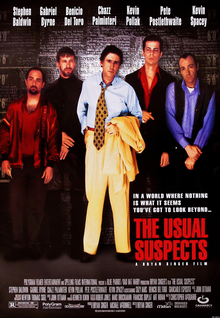
RETROSPECTIVE: The Usual Suspects (1995)

Director: Bryan Singer
Starring: Stephen Baldwin, Gabriel Byrne, Chazz Palminteri, Kevin Spacey, Kevin Pollak
Running Time: 106 minutes
Genre: Crime thriller

The Usual Suspects is my all time favourite film. Ever. It's one of the few films I've seen countless times and practically know every line off by heart. Everything about this film reeks of greatness. And it gets better with every viewing. That's saying something to the intricacy of the plot, the labyrinth plot and all round terrific performances on display. Director Bryan Singer and Christopher McQuarrie crafted a film so clever, so smart, that even on my gazillionth time re-watching it; I pick up on something new, a smile or a reference, something simple that wows me. It is a film so clever it makes you feel a bit silly at the end for getting duped. With the emergence of Tarantino as a premier film-maker in the earlier part of the 1990s, the crime genre became awash with cheap imitations and knock-offs of his work, the crime ensemble, the tough guys with sharp tongues, a taste for violence and visual flair filled with pop culture beats. Singer and McQuarrie wisely neglected to include the latter trait. There are no retro 70s classics, no talk about McDonalds and Burger King and so on. The film is very much a self-contained entity. And that's what makes it a masterpiece. Blissfully residing somewhere between the old fashioned crime caper and the aforementioned Tarantino stylism of the ninties, The Usual Suspects is too clever to resort to such things. Everything that happens is necessary in the overall context of the tale that is being told. And it's a mighty pay-off that lacks the bloated nature and unnecessarily over-long running time that often plagues films of this type. Everything about this film is perfection.

Kevin Spacey (as Verbal Kint) and Gabriel Byrne (as Dean Keaton)

The success of the film is in no small part to the magnificent cast. Gabriel Byrne gives a career best performance as Dean Keaton, a disgraced former cop who despite his best efforts to leave the crime world, is pulled down by vindictive former peers, including Agent Dave Kujan (Chazz Palminteri). Kujan meets with Verbal Kint, played by the wonderful Kevin Spacey, one of two who survived a brutal harbour shoot-out the night before. Kujan's mission is to find out if Keaton was one of the men that was killed. What follows is an intricate tale of five criminals as they become embroiled with a mysterious and myth like criminal named Keyser Soze. The crew, consisting of Keaton, Kint, McManus (Stephen Baldwin), Hockney (Kevin Pollak) and Fenster (Benicio del Toro). An early scene that cements their bond through being victimized as 'the usual suspects' for a police line-up sets the team up and they plan to get even on the corrupt police force. Keaton's reluctance puts Kint's role in the team at risk, but is persuaded by Kint after a heart-to-heart. Once the crew is assembled the action comes at a frantic pace. The robbery of a bunch of corrupt NYPD officers is a sharp and efficient set piece. It gives us an insight into both the solidarity of the team, but also that they are professionals. Again, if the five criminals were played by other actors they'd risk becoming generic cardboard canon fodder, but in Singer and McQuarrie's hands, each is uniquely likeable in their own way, even del Toro's Fenster who has far less screen time than the others, but still makes an impression ("Flip you, flip ya for real!") that you are rooting for the gang to succeed. 

One thing that is apparent from early on is that everything is not as it seems. Kujan, essentially represents us, the viewer and has enough intuition to know Kint is holding out. As Kujan finds out more (from other detectives interviewing a Hungarian survivor of the shooting) the plot thickens further. The introduction of Redfoot the Fence (Peter Greene) further adds to the mystery, with the crew now placed in danger and immediate threat. The scenes with Redfoot are some of the best in the film, and highlights the vulnerability of them under threat from the more powerful Redfoot and the introduction of Kobayashi (the late Pete Postlethwaite) into proceedings complicates matters further. Watching the group of macho males descend into paranoia and fear under threat from Soze is terrific in parts. Baldwin (in the performance of his career) as McManus and not like the man you'd probably know best recently as a member of Celebrity Big Brother is a revelation. In anybody else's film, Baldwin's McManus would be the lead, oozing charm, likeability and with machismo to spare. Similarly Pollak's Hockney is a secondary character, but is highly entertaining (thanks in part to Pollak's razor sharp delivery and wise-cracking sensibility) and you do nothing but root for him to succeed. While Kint's story too relegates himself to a secondary character, his petty criminal mixed in with career criminals make him a more relatable character and his wanting to get the job done without violence (well, unless it's necessary) make him the perfect narrator for the story. 

Stephen Baldwin (as McManus) and Kevin Pollak (as Todd Hockney)

But it is truly Byrne's Keaton that is the focal point of the film. Is Kint protecting him by making him out to be such a nice guy? All the questions that arise from Kint's story in contrast to Kujan's version of Keaton. It must be noted too that Palminteri excels as the determined cop who is essentially the straight man of the piece, he knows certain facts, but is drip fed information much like the audience and his piecing together of the facts is the same as the audiences. But back to Keaton, Kint's version of him is a highly complex character, a man whose life has seemingly been destroyed by his past, but does that even matter as do we ever know if he's telling the truth (well the finale clears this up, but we are left guessing practically until the final scene). And Kujan spiteful hatred of Keaton ("Dean Keaton was a piece of shit") further puts questions in Kint's representation of Keaton. With this in mind, it is still impossible not to root for the Keaton we experience. Initially a beaten figure, once he joins with the four he becomes the central figure of the operation with his insight into police procedures and gives the team enough information to do the job right. The mere mention of Soze to the four (excluding Kint, who hadn't heard of him) brings that forlorn and defeated look back and the sense of dread  that the films opening scene may actually be what happened and that Keaton didn't actually make it out of the harbour. 

Again, nothing is never as it seems and that's what makes this film such a job and complete mindfuck. The big harbour finale reeks of dread and something is really, really wrong here (along with all the brutal shootings of course). Certain films that tease this amount of complexity usually tend to fall off in the final act for a reveal so pointless and obvious that is ruins what came before it. The Usual Suspects does no such thing. The 'suspects' know they are in above their heads but resolve to do it anyway to get away from Soze's grasp. Whatever the outcome, they'll be free. Singer handles the action here with aplomb. The violence hits hard, but never feels unnecessary or becoming anything like gun porn. All the guns do is symbolize a threat that has been lingering for the 'suspects' for a long time, that Soze is close and the truth too (note in the scenes with Redfoot, his goons are heavily armed, but no action is taken, symbolizing the 'suspects' getting closer to Soze). Another part that drives the film is a fiendishly sinister score composed by John Ottman. From the opening theme right through, Ottman's score sets the mood. It is a strikingly gorgeous score that adds to an already strong central theme of mystery and intrigue for the film. 

Endlessly quotable, an iconic ensemble and perhaps the finest twist in modern film history, The Usual Suspects is not only the best film of the ninties, it is one of the all time greatest. A film that cleverly plays with genre expectations and turns them on their head, Singer and McQuarrie delivered the rarest of treats, a film as clever as it thinks it is, even on repeat viewings, the twists and turns hold up. The elaborate mixture of actuality and fiction mirror a truly wonderful piece of modern film-making. Add to the mix, an Oscar winning performance by Spacey (and screenwriting award for McQuarrie) and terrific all around performances beyond the usual filler typically associated with the genre and you have an all time classic. Just amazingly amazing.

95

The Suspects: Hockney, McManus, Fenster (Benicio del Toro), Keaton and Kint


TV REVIEW: The Shadow Line (2011)


Starring: Chiwetel Ejiofor, Christopher Eccleston, Stephen Rea, Rafe Spall, Antony Sehr
Genre: Drama

It is easy to forget that not too long ago British television was the pinnacle of programming. Long before the HBO's of this world came along, the BBC (and ITV too) were throwing out show after show of immense quality. The detective drama in particular being a staple of British television over the years and with The Shadow Line, the BBC have delivered a show that remains true to the age old BBC style, but adding modern threads of grit and themes utterly consistent with the finest shows from the States. The Shadow Line is not only the best British drama of recent years, it's one that down the line will be looked at in the same vein as Tinker, Sailor, Soldier, Spy as a classic of the conspiracy/noir genre, a complex and enthralling thriller that exceeds all expectations. 

From early on, creator, writer and producer Hugo Blick sets out to be different. The first scene in particular sets up that this is not your usual police procedural with an inexperienced rookie being shown the ropes at a crime scene by the shady Sgt. Foley (David Schofield) and this sets the ominous overtone for the series seven episodes. These opening exchanges hint at something far different than the usual detective mystery drama, with the thin line between the supposed good and bad guys being non-existent, each character is shadier than the last. Everything is not as it seems and the sense of foreboding bleeds in every darkly lit scene. Jonah Gabriel (Chiwetel Ejiofor) is a detective with a shady past of his own working on trying to solve the murder of a recently released crimelord, Harvey Wratten. On the other divide is Christopher Eccleston's Joseph Bede, a man trying to leave the criminal world, but whose own plans are thrown up in the air upon Wratten's death. Bede has to deal with his wife's illness and juggle an assortment of shady underworld characters, including the psychopathic nephew of Harvey, Jay (Rafe Spall), who is determined to kill his uncle's killer. Then there is Gatehouse (a creepy Stephen Rea), a man in the shadows seemingly controlling the show. Along with Spall's Jay, these are two of the most entertaining villains in recent television memory. Spall excels as Jay, delivering a performance that is terrifying and amusing in equal amounts. While the show is mainly laugh free, there are a few scenes that he brings chuckles, but never losing that menacing look. 

This makes Rea's Gatehouse all the more compelling and in complete contrast to Jay as he is a monster of a completely different kind. Quietly sinister and sombrely downbeat but intelligently played by Rea, his Gatehouse is the cold hearted centre of the series and whenever he appears, you know danger is near. As the show progresses, there are a stunning variety of twists, turns, shocks and genuinely disturbing moments. Gabriel's descent into this world and revelations about his own past and his secrets from his wife make him a compellingly flawed central character. Ejiofor is perfectly cast, varying from forlorn copper to a husband trying to juggle a series of mistakes and tribulations. Surprisingly violent, there are several moments throughout the show that will leave you speechless. There are too many sub-plots to go into detail here; with Tobias Menzies crusading journalist out to find the truth about Gabriel's past, or Bede's tragic relationship with his wife (Lesley Sharp), all taking up considerable time. But rather than weighing down the main plot line, these side plots build up the central characters and your connection with them, especially Eccleston's Bede, who becomes the tragic anti-hero of the piece, with you rooting for him to succeed. As the final episode begins, you wonder how on earth will Blick wrap this up and he succeeds in the most shocking and memorable way possible. For a show dedicated to focusing on near truths and deception, the finale is shockingly blunt and in your face. It is a terrific change of pace to a show that never tires of dropping hints and half-truths. The final scenes are the truth, whether you like it or not. 

The Shadow Line is a series of highly complex, clever set-ups and a pay off that is chilling, haunting and up there with the best in recent memory. Even the main theme (performed by Emily Barker) provides the perfect sound for the show, beautiful but with an underlying tone of threat and menace that will stick with you and haunt you long after it is over. This show is a compelling masterpiece. The plot is as deep and complex as they come and interweaves multiple angles. The performances are compelling (especially Eccleston who becomes the series heart and soul), and a final revelation that is nothing short of a shocking masterclass, The Shadow Line is television at its absolute best. A masterpiece.

92


Monday, 17 September 2012

Great Film Moments #1: Van Damme's monologue from JCVD (2008)

I won't lie, I've always been fond of Jean-Claude Van Damme. He starred in a few films that I loved when I was a kid, he kicked ass and was good at it. Recently his career has slumped a bit and has starred in his share of clunkers, but a few gems have appeared in his DTV career like the awesomely fun Universal Soldier: Regeneration and films like Assassination Games and Until Death, which were solid B-movies. But most have been throwaway clunkers while not as bad as Seagal's fall from grace, but still nonetheless not near his usual entertaining, fun and generally nonsense action films that he made in his heyday (Timecop, Universal Soldier etc.). 

Then 2008's JCVD came along. A surreal film. A meta-philosophical action drama in French about a has-been actor caught up in a bank robbery. What followed was a revelatory performance from an actor whose acting range was never even considered. And that's what makes this scene all the more monumental. And heartbreaking. The meta-project line is crossed and we are presented with a monologue that is perhaps more personal confession than Van Damme acting, but by fuck is it outstanding. It is a moment of breathtaking brilliance and beauty, something that it rarely seen on-screen these days; raw emotion. So much so, Time magazine called it the second best performance of 2008, second only to Heath Ledger's now iconic Joker portrayal in The Dark Knight. That tells you of the strength of the performance here. It is a jaw-dropping scene and performance from Van Damme. Career redefining, putting his excesses of the 90s and his personal addictions in context and giving him a second chance to perhaps turn the tide on his career to some extent. 


Thursday, 13 September 2012

UNDERRATED ACTORS: Peter Greene


Peter Greene has long since been one of my favourite supporting actors. This may be rooted in his performance in my favourite film of all time™ The Usual Suspects as the sinister and to be honest, absolute badass Redfoot. Many will know him from his role in Quentin Tarantino's Pulp Fiction as Zed - "Zed's dead baby, Zed's dead!". Others will know him as the villains in both The Mask and, erm, Martin Lawrence's Blue Streak. After coming to public attention for an acclaimed performance in the little seen Clean, Shaven, as the lead character with schizophrenia, Greene got cast in roles usually as the villain or a secondary henchman. Starring in two of the most iconic and popular films of the 90s and you think Greene would have been set. But like many talented performers, temptations can take their toll, which perhaps hindered his status as a reliable performer much like another actor I'm fond of, Tom Sizemore (Saving Private Ryan, Heat and countless other roles). Much to my joy, however, Greene has re-emerged recently, albeit in supporting bit-parts on television shows and cameos in films like Training Day in 2001. He had a superbly entertaining cameo in the opening scene of Timothy Olyphant led crime show Justified in 2010, which again exhibited his intensity and ability to portray quiet but psychotically dangerous villains. Last night, he popped up on a show I began watching the other night (from 2007), The Black Donnellys, again as a villain. But his calm and calculated Dokey is a breathe of fresh air in a show that doesn't know if it wants to be The Sopranos or The OC and elevates the show in the process. While having a latter CV of films I know little or heard little about, his recent more high profile appearances on television suggest that there's life left in the underrated bad ass yet. Embedded below are probably two of the best moments of 1995's The Usual Suspects. 


Wednesday, 29 August 2012

Great TV Moments #1 - Mike's Speech in Breaking Bad


*Breaking Bad spoilers yo*

The rise of Mike Ehrmantraut (Jonathan Banks) in Breaking Bad coincided with the rise of the show to becoming one of the best shows currently on air. While the main character of Walter (the immense Bryan Cranston) will be the shows most iconic face, it is the smaller and supporting characters that have made Walter's journey all the more entertaining, characters like the amusing Saul (Bob Odenkirk), Gale (David Constabile) and so on. But Mike is the stand-out, by far. His rise to prominence from his first appearance at the end of season 2 to this scene in the twelfth episode of season 3 is staggering. And after the events of the first part of season 5, this scene has become all the more poignant. 

The scene is a simple story from Mike's past as a cop. But the delivery and the intricacy of the writing is astonishing. You can feel that this is a memory that has plagued him since it happened, every word carefully picked and recited in his head a million times. And it makes his character come full circle as to how such a seemingly noble character could become involved in Gus Fring's (Giancarlo Esposito) drug operation and involved in organized crime. Banks absolutely owns this scene. For a character that rarely shows emotion in the show, it is a truly touching scene. His story of little relevance to the overall plot of the story, but is delivered with such impact that affects Walt in the worst possible way. 

"The moral of the story is; I chose a half measure when I should have gone all the way. I'll never make that mistake again. No more half measures, Walter".


Tuesday, 21 August 2012

FOOTBALL: The Perfect Start


It would be easy to get lost in the excitement of having the Premier League back on our screens and one 5-0 victory under the belt, but after a mixed summer (some inexpensive quality signings, but several key players leaving/or wanting to) this is the best possible start for Fulham. Despite this wonderful start, for me, the goal is still the same; avoid relegation first and foremost and build from there. That being said, there is nothing wrong with lapping up the team being top of the Premier League for the sheer token value of it. It's rare for a club of Fulham's stature to be sitting atop the league, and even if it's after a single game, it's still a smug grin inducing affair. Especially with the troubles big Martin Jol is having with want away Clint Dempsey and seemingly big clubs looking at Moussa Dembele too. 

It would not surprise me if they both left. They are both terrific players and no doubt could cut it at a top 4 team. Dembele in particular is quickly becoming one of the finest talents in the Premier League and a big move is only a matter of time. And at only 25, his best years are definitely ahead of him. As fond as I am of Clint Dempsey (and even despite his apparent disappointing behaviour), it will be a shame to see him go, but a necessary one. His personal ambitions have outgrown the modest clubs secure environment (or his desire to move to a 'bigger' club at least) and from that moment, he has to go. It's not good for the team morale or any of the younger talents the club has coming through to see Dempsey's behaviour and think it's an acceptable means of forcing a move. Despite all this, Clint has been a terrific player for us and have been a pivotal player for us and given the club some of his finest displays. I wish him all the best at whatever club he goes to. But now, back to Saturday and the wonderful 5-0 thumping of Norwich City. Absolutely terrific stuff. Mladen Petric may very well be one of the signings of the season if he is half as good as his performance Saturday suggests with two well taken goals. Youngster Alex Kacaniklic also gave a good account and is definitely a talent in the same vein of Kerim Frei. Bryan Ruiz will have to have a big season to fill the boots left by Dempsey (and possibly Dembele) and surely his second season with the club will be a more consistent one. It would be easy to get carried away with this win, but it must be said that Norwich had a shocker and that the next 37 league games won't be anywhere as easy as this and with a trip to Old Trafford to come next week against a no doubt fuming Manchester United team after their loss at Everton Monday night, the team will do very well to sneak something from the game.

A good start to the season then. We have lost quite a few squad players this summer with the legnendary Danny Murphy leaving, as well as players like Dickson Etuhu and Andy Johnson, so hopefully Jol can strengthen the squad further before the transfer deadline closes and keep Dembele and build a team around him. United in four days time at Old Trafford will be a completely different game altogether and I except us to be firmly brought back down to reality. But for the meantime, we are officially top of the table!


Friday, 17 August 2012

HEROES: Mark Lanegan

Mark Lanegan is a legend, pure and simple. His career from the early years with the Screaming Trees as a pioneer of what would become known as the 'grunge' sound to his recent solo and collaborative efforts have established him as one of the consistently finest creative minds performing. His trademark raspy baritone voice remains a unique presence in the modern music landscape. While Screaming Trees might not be as recognizable or as well remembered as later bands that came to symbolize the Seattle sound of the late 80s/early 90s, they like other and perhaps even less known bands (in mainstream terms anyway) like Green River, Mudhoney and Mother Love Bone. While never achieving this multi-platinum success of the big four (Nirvana, Pearl Jam, Alice in Chains and Soundgarden), their 1992 album Sweet Oblivion remains one of the finest releases of that generation with hits like Nearly Lost You and Dollar Bill featuring trademark Lanegan delivery. 


No One Knows by Screaming Trees from their album Sweet Oblivion (1992)

During the successes of the Trees, Lanegan began releasing solo material and again while never getting the sales success, maintained a healthy progression in his writing and singing abilities. His second solo album in particular, Whiskey for the Holy Ghost, exhibits a vulnerability not previously seen in his work and would become a prime theme in his works. Songs like The River Rise and Kingdoms of Rain exhibit this softer sounding but more emotionally intense work. His work with Screaming Trees was on-and-off during the mid-to-late nineties and finally came to an end in 2000 after their final release together Dust, which was released in 1996 to again positive reception. In 2011, eleven years after the bands breakup, songs from their recording sessions in 1998/99 were released in a collection called Last Words: The Final Recordings, containing some trademark Trees sounding material. All in all, of all the collection albums released by bands after their demise; this was certainly one of the better collections, containing authentic and not altogether overly edited or changed songs, but suffering from the same problems that collections have. It also shows the development in sound the band have over the final four years of the band. 

The River Rise by Mark Lanegan from his album Whiskey for the Holy Ghost (1994)

In addition to his word with Screaming Trees and his wide collection of collaborative efforts, he has released seven solo albums, with his most recent being Blues Funeral (released under the name Mark Lanegan Band). Safe to say this album rekindled my love with his music. Blues Funeral is a devastatingly effective album, combining Lanegan's trademark vocal delivery with a new production style, a shift for a straightforward/alternative rock sound to a combination of electronica and guitar elements in one of the finest albums of 2012. It would take an age to go through each album and pick out highlights. But for each listener, if they enjoy Lanegan's sound, there is something for everyone to find. All released to positive critical reception, yet while again not being outstanding commercial but consistently moderate successes, it remains testament to Lanegan's appeal that he has established a strong core fanbase to equate to the high reception his work has received. 

Harborview Hospital by Mark Lanegan Band from their album Blues Funeral (2012)

Over the years, Lanegan has collaborated with the likes of Queens of the Stone Age, Mad Season, P.J. Harvey, Isobel Campbell, Greg Dulli, Soulsavers, Unkle and a variety of others. His collaborations with Soulsavers in particular show another side of Lanegan's output. In the two albums he was featured on with the 'savers, and especially in the first album, It's Not How Far You Fall, It's The Way You Land, shows a more expressive and vocally impressive Lanegan, his range on display and being a highlight of tracks like Revival and No Expectations. Perhaps he has received most mainstream attention for his work with Queens of the Stone Age on three of their albums, including backing/lead vocals on several songs, most notably their biggest hit, No One Knows, from 2002's Songs for the Deaf. 

Revival by Soulsavers from their album It's Not How Far You Fall, It's the Way You Land (2007)

His ongoing collaboration with Greg Dulli as part of The Gutter Twins has been another source of critical acclaim for the duo. Lanegan and Dulli's co-vocal blues-rock delivery show another darker, heavier side to Lanegan's catalogue, with Dulli reaching the higher notes, but with Lanegan giving the depth and filling out most tracks. Tracks like Idle Hands displays this heavier sound, dual vocal delivery. The album contains a variety of sounds and influences, with orchestral elements being used in the track The Stations. Despite the praise the album received, no follow up has been released despite touring in 2009. The band is currently inactive. 

Idle Hands by Gutter Twins from their album Saturnalia (2008)

Since the release of Blues Funeral, there has been another reason for rejoice with the news that along with original Mad Season members Mike McCready (of Pearl Jam) and Barrett Martin (of Screaming Trees), Lanegan will be performing lead vocals on a new album from the group, their first since 1995. Although two original members, Layne Staley (whom he was close friends with) and John Baker Saunders, have died, it is fitting that Lanegan should be involed. Considering he was involved in the first album, Above, it is poignant that Lanegan will be part of the album and if anywhere near as good and beloved as the first album was, should be a treat. 


Long Gone Day (Live) by Mad Season from Live at the Moore Theatre

Mark Lanegan has had a long and varied career. He has overcome personal hardships (drug addiction in his youth) to become a highly respected figure in alternative music and has remained a relevant and creative figure through almost three decades of a changing rock scene and has become a prime and influential figure, which is emphasised by his latest release, Blues Funeral, that is receiving some of his best notices of his career. With a large and varied catalogue of work and only being 47 years old, we have still plenty more to see from Lanegan, be it in his sole or collaborative works.